Embroidery suits plush doll faces built from clear shapes and visible stitch texture. Printing can suit fine artwork, gradients or multiple small color areas, depending on the fabric and printing process. Choose by evaluating a finished, stuffed sample: a flat decoration swatch cannot show how the expression changes across a curved face.
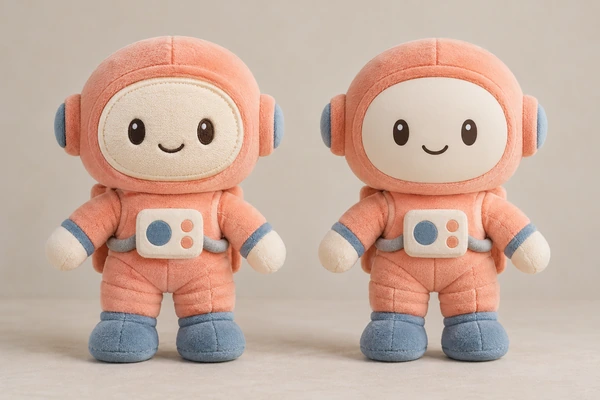
For a peach astronaut in a custom plush doll collection, the decision might involve only two eyes, a smile and cheek color. Those few marks carry the character’s identity. Approve their position and appearance as carefully as the body shape.
What changes when thread creates the face?
Embroidery introduces stitch direction, density, backing and local firmness. A small smile that looks clean in vector artwork may become heavy when stitched. A narrow gap between eye highlights may close visually. Ask the supplier to show the proposed embroidery on the actual face fabric, at final size, with the intended backing.
Backing selection is material-dependent. Madeira’s stabiliser selector organizes choices by fabric properties and other criteria; it illustrates why one backing should not be assumed suitable for every plush surface. Include this discussion in your OEM and ODM brief before approving a sample solely from its front photograph.
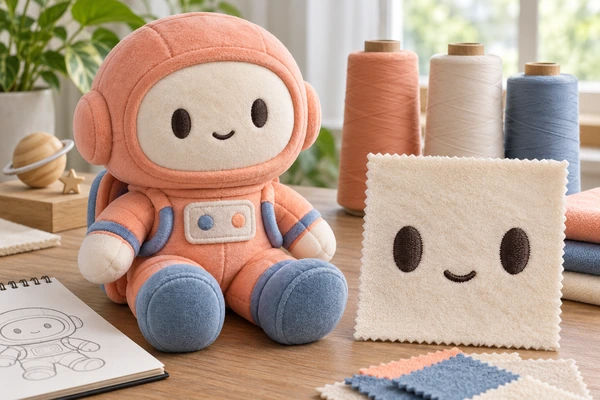
What does “printed face” actually mean?
Ask for the exact process. Sublimation, transfer and other textile printing methods have different material and production implications. Epson’s sublimation guidance explains the polyester requirement and the preference for light substrates. That guidance applies to sublimation, not to every form of printing.
Request a print proof on the intended fabric, including a close view and a normal viewing-distance photograph. Look for blurred edges, color shifts and differences in surface feel. If a transfer layer is proposed, ask how it behaves when the fabric bends and the doll is handled. Agree on a relevant evaluation method rather than accepting “permanent print” as a complete specification.
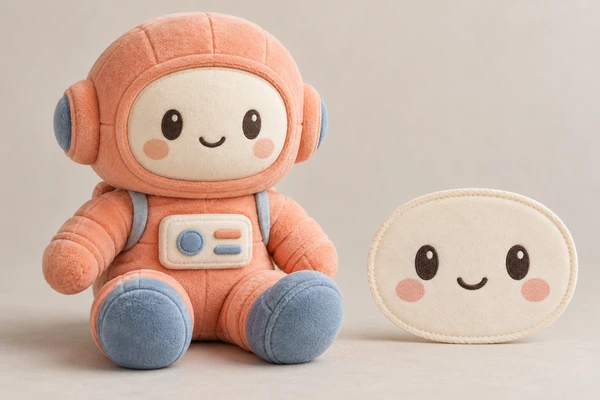
Compare the same expression, not two different drawings
| Review point | Embroidery sample | Printed sample |
|---|---|---|
| Fine features | Check stitch readability and gaps | Check edge definition on the fabric |
| Surface | Check raised texture and backing feel | Check hand feel for the chosen process |
| Curvature | Check puckering and eye alignment | Check distortion after stuffing |
| Repeatability | Record approved stitch file and setup | Record artwork, process and color proof |
Supply editable source artwork and a reference export. Adobe’s raster and vector overview helps explain why a screenshot may be insufficient for production preparation. Identify which dimensions are fixed and which may change after technical review.
Use physical color references alongside digital files. Pantone’s guidance on physical samples is a useful reminder that a screen alone is not a complete color approval system. Thread, ink and fabric can look different even when they aim at the same reference.
Inspect the face after assembly
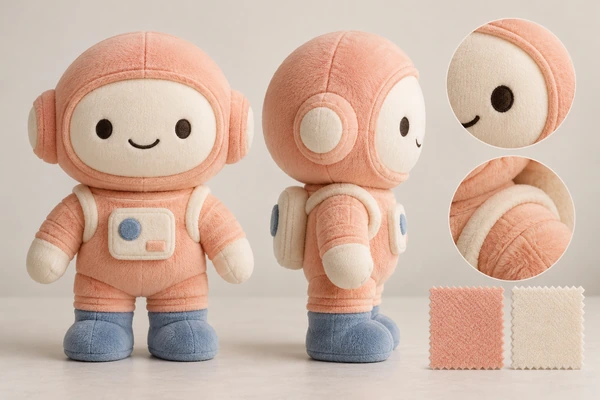
Request front, side and three-quarter views of the stuffed doll. Check eye spacing against a defined centerline, distance from the face seam and whether pile obscures details. Compare the expression upright and in the pose customers will see on the shelf. A face that looks balanced when laid flat may appear tilted after assembly.
Discuss seam placement through the manufacturing review. The Coats soft and secure seams guide provides broader sewing context; your own acceptance criteria must still match the doll’s materials and use. Add the approved face views to the quality-control reference.
Resolve care, safety and revisions before the order
Compare quotations using the same artwork, fabric, quantity and approved appearance. Request separate identification of development charges, sample revisions and any production setup charges. A low decoration price can become misleading if one quote assumes a simplified face while another includes every highlight. Ask how a size change affects the method, because simply reducing the artwork may not preserve its expression.
A hybrid approach is also possible: embroidered eyes with printed cheek color, for example. Treat it as a third construction requiring its own approval. Check alignment between the two processes and record the acceptable variation. More techniques can create more opportunities for mismatch, even when each individual decoration looks attractive.
Neither method automatically makes a toy safe or washable. Review the finished product against applicable requirements, using CPSC toy safety guidance for US planning and ISO 3758 as a care-labeling reference. Ask what evidence supports the care claim for this particular combination of decoration, fabric and filling.
Keep a dated approval record linking artwork, materials and sample photographs. ISO 10007 configuration-management guidance offers a useful organizing principle for controlling revisions. A changed smile should trigger a documented review, not an informal message buried in a chat.
Review the project FAQ and company introduction, then send your face artwork with the target size and audience. Request comparable samples before selecting the production method.
Illustrations are design concepts, not test results or approved production samples.
Prepare your decoration approval inquiry
Copy and complete this brief; mark unresolved items to confirm.
Company / contact:
Product / size / intended use:
Market / quantity / arrival date:
Artwork version:
Production materials:
Approval reference:
Email This BriefWhatsApp This Brief
Review and send it yourself, or paste it into our inquiry form.