
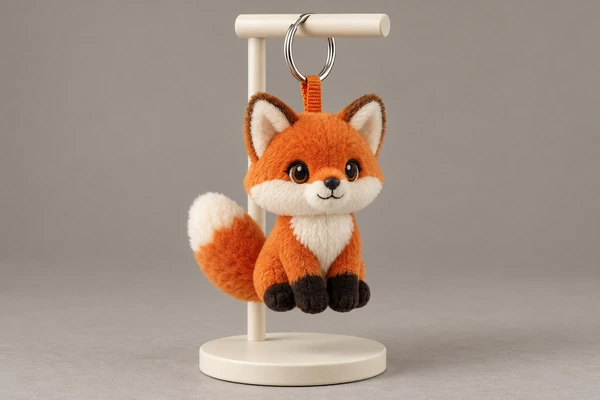
Choose plush keychain hardware by starting with the object it will attach to and how often the customer will remove it. A split ring suits a more permanent connection; a spring clip makes frequent attachment easier. Neither choice settles the whole design. The connector, fabric loop and sewn anchor must work together as one assembly.
For accessory buyers developing plush keychains and bag charms, the useful question is practical: can the intended customer attach, carry and remove the finished product comfortably?
Start here: what does the charm connect to?
Put the actual bag, zipper pull or key bundle on the sampling table. Measure the attachment point and identify whether it is rigid or flexible. A clip that looks generous in a photograph may not pass around a padded handle. Conversely, an oversized fitting can dominate a miniature fox and pull it into an awkward hanging position.
Check the supplier’s customization process before choosing from a photograph. Request a hardware sample, its dimensions and material description. Use the following comparison to narrow the options, then test the complete product.
| Option | Useful when | Check on the sample |
|---|---|---|
| Split ring | The connection changes infrequently | Ring thickness, opening effort and edge finish |
| Spring clip | Customers move the charm between bags | Gate clearance, closure and finger access |
| Swivel connector | Orientation changes during use | Rotation, play and the additional joint |
| Fabric loop | A soft bridge connects plush and fitting | Loop length, reinforcement and stitch placement |

If quick removal matters, examine the opening
Operate the clip repeatedly with the proposed plush attached. Check that the gate opens far enough and closes fully without catching pile, thread or the hanging loop. Record the required opening clearance rather than relying on the clip’s overall length. Those are different measurements.
A swivel can help the charm turn, but also adds another joint to inspect. YKK’s LN-Z product information illustrates a rotating hardware format; it is a reference for discussing geometry, not proof that a particular fitting is suitable for your product. Obtain the specification for the component actually quoted.
If the connection is permanent, check the ring and loop
Inspect the ring for rough edges and visible distortion. Check whether assembly damages the loop or leaves snagged fibers. Ask who assembles the ring and whether production workers need a tool to avoid inconsistent handling. Include that operation in the manufacturing discussion.
The sewn anchor deserves as much attention as the metal. A neat-looking loop can still pull on a weak section of fabric. Ask how load is distributed into the body and where reinforcement belongs. Coats’ seam-strength guidance explains why thread, fabric and seam performance must be considered together.
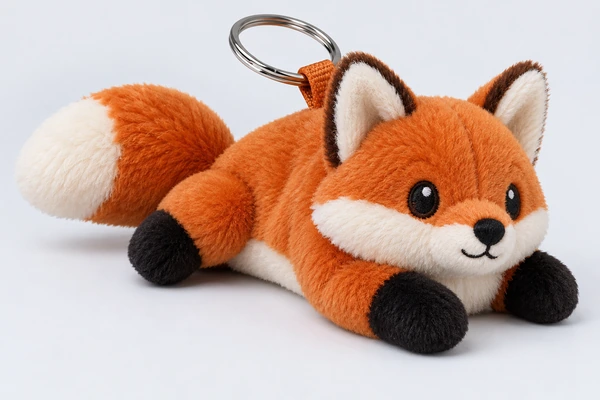
Set inspection criteria before bulk production
Use an approved assembly sample and photographs of the connection from both sides. Define acceptable loop length, fitting orientation, finish appearance and seam position. Agree how functionality and attachment strength will be evaluated under the applicable specification; do not invent a universal pull-force threshold from another product category.
Discuss the inspection sequence with the quality-control team. If the charm is a toy for the US market, review CPSC toy requirements and the separate small-parts guidance. Calling an item a bag charm does not by itself resolve its classification or intended age group.
Where third-party testing is required, check the laboratory’s relevant scope using the CPSC laboratory directory. Appearance checks and everyday handling trials do not replace applicable testing.
Does the hardware work with the packaging?
Hang a packed sample on the intended display peg. Check whether the charm faces forward, whether metal rubs against the plush, and whether the customer can understand the attachment without opening the pack. Review relevant ordering questions before agreeing the packing configuration.
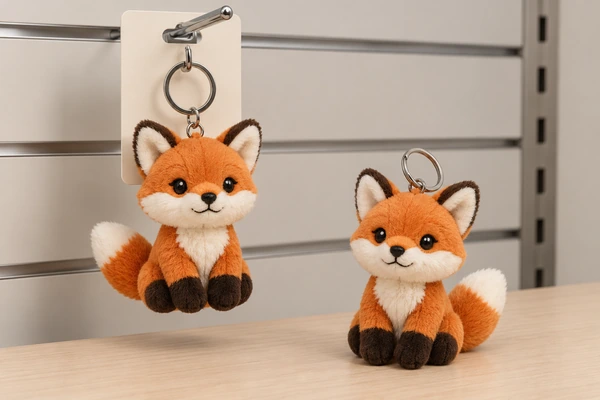
Protect the fitting during transit without hiding the product. Discuss a suitable packaged-product test using ISTA’s procedure overview. When hardware options become separate retail variants, consider identification under the GS1 GTIN rules.
The final buying decision
Keep a finish reference alongside the plush sample. Compare later fittings under consistent lighting and check for visible scratches, rough plating or color differences. Describe the finish precisely in the purchase specification, including any agreed restrictions. A photograph can support the record, but it should not be the only reference for accepting production hardware.
Compare complete assemblies, not loose hardware prices. A cheaper clip can lose its advantage if it needs extra packing, slows assembly or makes the charm hang poorly. Record the selected component, finish, loop material and approved sample revision. ISO 10007 configuration guidance provides a reference for controlling those decisions.
Review the supplier’s company information, then send your keychain specification with the intended attachment point and a photograph of the bag or display. That gives the sampling team a functional target rather than a fitting name alone.
Prepare your plush accessory specifications inquiry
Copy and complete this brief; mark unresolved items to confirm.
Company / contact:
Product / size / intended use:
Market / quantity / arrival date:
Size and attachment:
Retail variants:
Assembly check:
Email This BriefWhatsApp This Brief
Review and send it yourself, or paste it into our inquiry form.
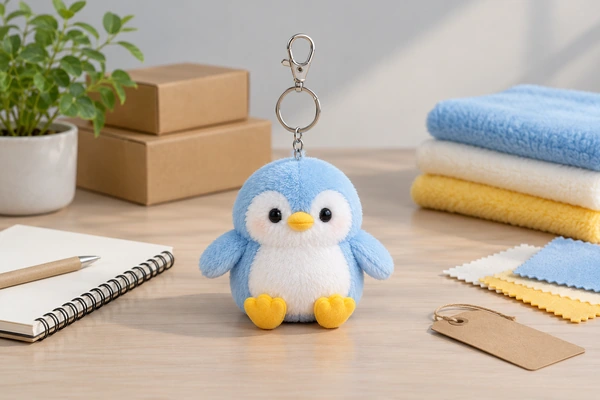
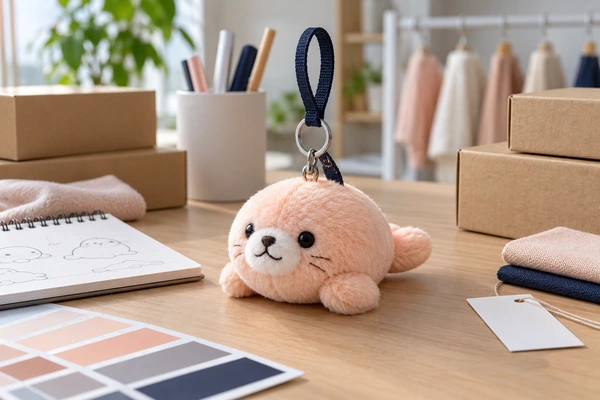
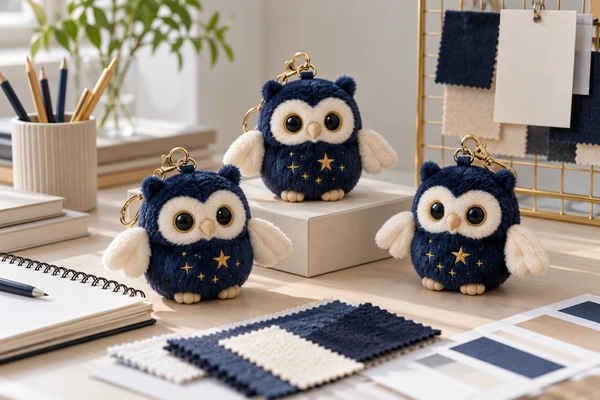
[…] decoration, fabric loop, connecting ring, clasp and packaging. The questions below build on our hardware selection guide. They are a framework for discussions with your supplier and qualified compliance specialists, not […]