
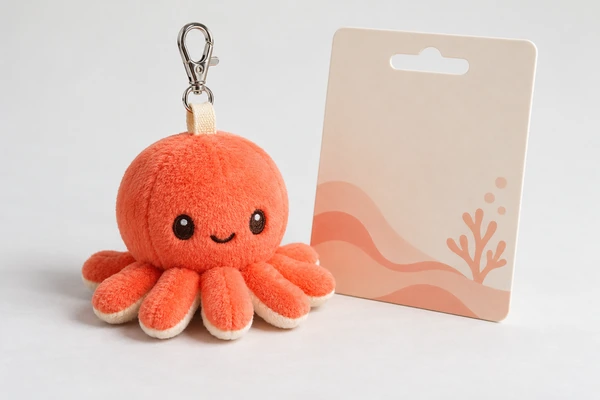
Choose plush keychain packaging by testing how shoppers see, pick up and return the product in the intended display. Peg cards need reliable hanging geometry and clear visibility. Countertop trays need accessible products, readable variant information and simple replenishment. The best format is the one that works with the store’s actual fixtures and staff routine.
A coral octopus concept in a plush keychain range provides a useful test item: its rounded arms create width, while its ring or clip changes how it hangs. Begin with a physical display experiment instead of approving a flat packaging drawing alone.
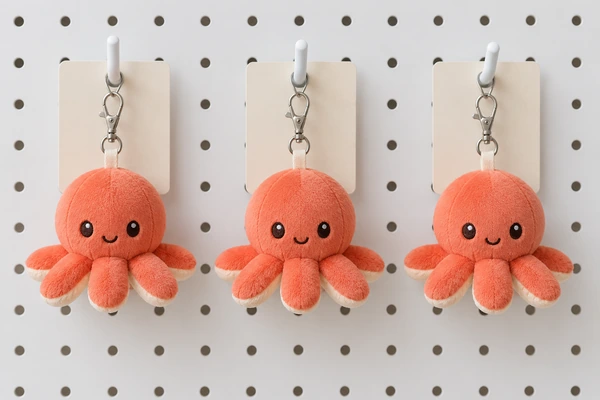
Experiment A: put the sample on a real peg
Use the retailer’s hook dimensions and spacing. Hang several packed units at the intended depth, then view the display from normal shopping distance. Check whether the front card remains upright, whether the charm twists and whether hardware from adjacent products catches together. Photograph the arrangement before anyone adjusts it for presentation.
Record card dimensions, hole position, attachment method and the loaded product’s position. The GS1 package measurement standard helps organize consistent dimensional data. Add the fixture requirements to your custom packaging brief, including any limits imposed by the retailer.
Ask a person unfamiliar with the design to remove one unit and return it. Observe whether they bend the card or need to disentangle the clip. A package that hangs neatly when untouched can still perform poorly during ordinary handling. Keep notes on the failure mode rather than simply labeling the design “bad.”
Experiment B: fill a countertop tray
Load the proposed tray with the planned number of units. Check whether all faces remain visible and whether tags cover adjacent products. Remove several items, then inspect the partly empty display. A tray should still communicate the range after sales begin, not only when it is perfectly full.
Test replenishment using the intended inner pack. Can staff refill without sorting tangled rings or unfolding every tag? Discuss assembly and packout through the manufacturing review. A modest change to tag position or packing orientation may reduce handling without changing the charm itself.
Use assortment planning principles to decide whether colors share one tray or need separate compartments. Do not assume an equal color mix suits every store. A clear variant identification system helps staff replenish the intended design rather than whatever remains nearest the top of the carton.

Compare the two formats fairly
Keep the product, price and number of available units comparable during a store trial. Record fixture location and trial dates, since a counter beside the checkout has different exposure from a peg at the rear of the store. Ask staff to note customer handling problems and refill time as well as sales. These observations help explain why one format works better in a particular location.
Make the acceptance sheet specific: the card should remain usable after ordinary pickup and return, the face should remain visible in the agreed display, and the packed assortment should be identifiable without opening every individual unit. Decide how to evaluate those conditions with the buyer. Do not invent a universal pass threshold for fixtures you have not tested.
| Check | Peg format | Countertop format |
|---|---|---|
| Visibility | Face and front card remain forward | Products remain identifiable as stock falls |
| Handling | One item releases without tangling | One item lifts without pulling neighbors |
| Replenishment | Cards align with fixture spacing | Inner packs refill the tray efficiently |
| Information | Barcode and copy are accessible | Variant and price information stay clear |
Confirm product identifiers with the buyer using the GS1 GTIN Management Standard as a reference. Check barcodes on the actual printed stock and finished package, not only on a PDF proof. Store reporting such as Shopify inventory reports can help review sell-through later, provided variant records are consistent.
Keep packaging claims and product requirements clear
For a product intended as a US toy, review the CPSC toy safety guidance and small-parts guidance. Packaging style does not determine age suitability. Agree on required information and any components intended to be removed before use.
Support environmental packaging claims with evidence. The FTC Green Guides summary is relevant when reviewing claims about recycled or recyclable materials. Keep material descriptions precise and avoid treating the visual appearance of kraft paper as proof of a particular environmental benefit.
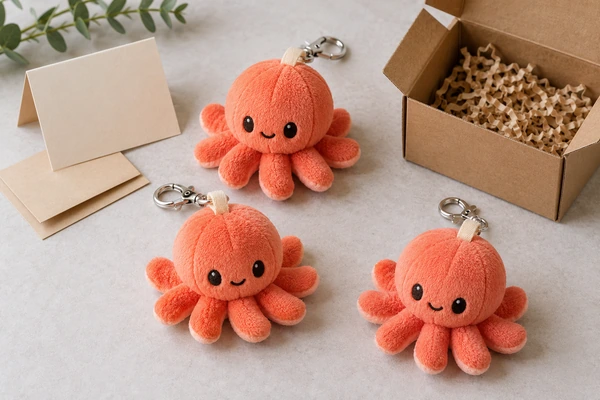
Approve the shipping pack as well as the display
Review transport protection with reference to suitable ISTA test procedures. Check card bending, surface rubbing, hardware contact and tray deformation after the agreed evaluation. Include those observations, assortment counts and label accuracy in the quality-control plan.
Review the sourcing FAQ and company overview, then share your display specification with fixture dimensions, quantity per pack and store handling requirements.
Images are original packaging concepts. Actual display performance requires testing with the retailer’s fixtures.
Prepare your pack-out planning inquiry
Copy and complete this brief; mark unresolved items to confirm.
Company / contact:
Product / size / intended use:
Market / quantity / arrival date:
Selling unit:
Packing layout:
Receiving check:
Email This BriefWhatsApp This Brief
Review and send it yourself, or paste it into our inquiry form.

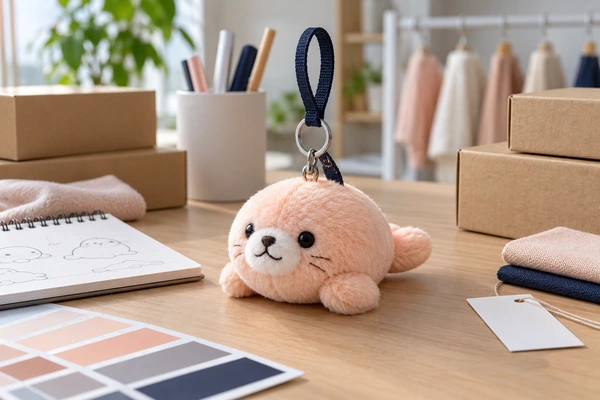
[…] fixture. Check faces, hardware, backing cards and appearance as colors sell through. Use the retail packaging guide to define whether the shipment contains fixed mixed cartons or separate color […]