

Check plush pillow shape recovery by comparing a documented baseline with the same product after a defined compression, storage and unpacking process. Measure more than overall thickness: inspect seams, corners, decorative parts and the retail appearance. Agree on the method and acceptance limits before using compression packaging for a bulk order.
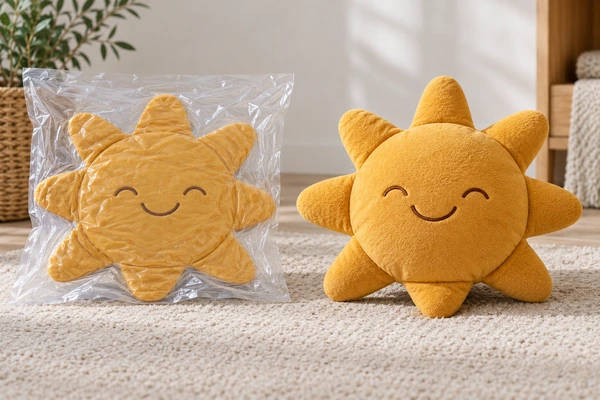
An ochre sun cushion illustrates the issue. Its center may regain volume while individual rays remain bent. For a plush pillow assortment, recovery needs to reflect the whole design and the customer’s unpacking experience. The workflow below is a proposed buyer protocol, not a universal test standard.
1. Define the packaging trial
Record the exact sample version, cover fabric, filling specification, fill quantity and finished dimensions. Identify the bag, sealing method, compression method and packed dimensions. Include the planned storage duration and environmental conditions. A brief tabletop squeeze does not represent an extended journey in a compressed package.
Discuss these variables in the packaging development brief. Use the revision-control principles of ISO 10007 to keep the trial linked to a specific construction. Results from one filling or cover should not silently be transferred to a changed version.
2. Record the uncompressed baseline
Allow samples to reach the agreed starting condition. Photograph front, side and back against a consistent background. Measure width, height and thickness at marked reference points without applying inconsistent pressure. Record the pose and orientation so the later comparison can be repeated by someone else.
Use consistent dimensional definitions, with the GS1 measurement standard as a product-data reference. If dimensions are reported in both centimeters and inches, follow reliable NIST conversion guidance and avoid misleading precision. Retain original measurements rather than repeatedly converting rounded numbers.

3. Pack, store and unpack consistently
Apply the intended process to more than a single handpicked example where feasible. Record sample identities and actual trial conditions. Keep an uncompressed reference if the evaluation plan calls for one. Ask the supplier to document any handling that differs from the process intended for the commercial order.
Review the packing sequence through the manufacturing discussion. If transport performance also needs assessment, select appropriate ISTA procedures with your logistics or testing partner. A shape-recovery trial and a distribution test answer different questions and may both be necessary.
On unpacking, follow only the handling instructions you intend to give customers. Record whether fluffing, shaking or another action is allowed. Do not rescue a poor result using unplanned heat or aggressive manipulation and then present the recovered sample as representative of ordinary unpacking.
4. Review at agreed observation points
| Observation | Record | Reason |
|---|---|---|
| Immediately after opening | Dimensions and visible deformation | Shows initial customer experience |
| At agreed later intervals | Same measurements and photographs | Shows recovery progression |
| At the final decision point | Appearance and functional acceptance | Supports the packaging decision |
Choose observation intervals appropriate to the product and sales channel; do not assume one recovery time applies to all pillows. A store that needs immediate shelf presentation may have a different requirement from a product with clearly explained unpacking instructions. Document that requirement before reviewing the results.
5. Inspect details that thickness can miss
Check filling distribution, surface creases, seam distortion, embroidery and the sun’s individual rays. The Coats soft and secure seams guide provides sewing context for the construction discussion. Add product-specific appearance criteria to the quality-control checklist rather than relying on a single dimension.
Keep recovery instructions separate from cleaning instructions. ISO 3758 is a reference for textile care symbols, not proof that steaming or washing is an appropriate recovery method. Any recommended treatment needs support for the actual materials and construction.

6. Make a documented packaging decision
If thickness is tracked as a recovery ratio, define the calculation explicitly: measured thickness at the observation point divided by baseline thickness, multiplied by one hundred. Use the same measurement location and method for both values. This is a descriptive comparison, not a complete pass criterion; a high ratio can coexist with distorted rays or a visibly uneven filling distribution.
Retain the photographs and individual measurements rather than reporting only an average. Variation between samples may matter to the retailer’s presentation requirements. If results are inconsistent, investigate the materials and packing process before expanding the trial or changing the acceptance limits.
Record pass, revise or reject against the agreed criteria. The process approach described in ISO 9001 offers useful quality-management context, but certification alone does not establish recovery performance. Compare packaging savings with additional handling, presentation risk and the defined shipping scope under the agreed Incoterms framework.
Consult the buyer FAQ and company introduction, then request a documented compression trial for your design and route.
Images illustrate trial setup concepts. They do not show measured recovery results or a validated recovery time.
Prepare your pack-out planning inquiry
Copy and complete this brief; mark unresolved items to confirm.
Company / contact:
Product / size / intended use:
Market / quantity / arrival date:
Selling unit:
Packing layout:
Receiving check:
Email This BriefWhatsApp This Brief
Review and send it yourself, or paste it into our inquiry form.


