

Calculate carton volume for wholesale plush pillows using the outside dimensions of the closed shipping carton, then multiply by the number of cartons of that size. If dimensions are in centimeters, divide length × width × height by 1,000,000 to obtain cubic meters. This gives physical volume, usually written as CBM. It does not, by itself, determine the final freight charge.
Work through one packing example
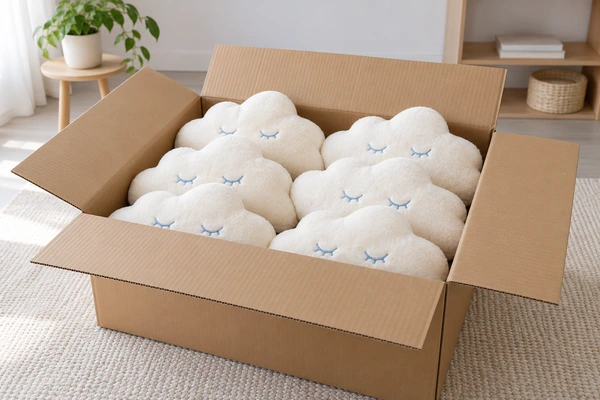
Suppose a completed carton measures 60 cm × 40 cm × 50 cm and contains 12 cloud pillows. Its volume is 0.60 × 0.40 × 0.50 = 0.12 m³. For 20 identical cartons, total volume is 2.40 m³ and quantity is 240 pillows. The volume per packed pillow is 0.01 m³. These figures are an illustrative calculation, not a recommended packing specification.
| Packing line | Calculation | Result |
|---|---|---|
| One full carton | 60 × 40 × 50 ÷ 1,000,000 | 0.12 m³ |
| Twenty full cartons | 0.12 × 20 | 2.40 m³ |
| One different carton | 60 × 40 × 30 ÷ 1,000,000 | 0.072 m³ |
| Combined shipment | 2.40 + 0.072 | 2.472 m³ |
Calculate each carton size separately. A partly filled carton still occupies its full external volume unless it is physically repacked into a smaller carton. Use consistent units, with NIST conversion references where needed, and retain enough precision until the carrier’s rounding rules apply.

Measure the packed carton rather than the empty specification
Ask for measurements after the carton is filled and sealed. Bulging sides, projecting closures or an oversized protective layer can change the shipping envelope. Confirm whether the quoted carton dimensions are internal or external. Connect this information to the approved finished cushion dimensions; a revised pillow can invalidate an earlier packing estimate.
Record units per carton, net product weight, gross carton weight and packing method on the same sheet. The International Trade Administration’s document guide explains the role of packing lists among shipping documents. Reconcile totals against the purchase order and final packing list, rather than treating a preliminary quotation as the dispatch record.
Keep CBM separate from dimensional weight
Parcel and air services may charge using dimensional weight under their own rules. For example, FedEx’s published Australian guidance describes a centimeter-based divisor of 5,000 with upward rounding of dimensions. Under that illustrative divisor, the 60 × 40 × 50 cm carton represents 24 kg dimensional weight. Verify the applicable service, contract and rounding method before using a divisor.
Actual gross weight remains a separate measurement. Ask the forwarder how chargeable weight or volume is determined for your route, including minimum charges and handling fees. Use the supplier quote comparison to align freight assumptions. The ICC Incoterms overview helps clarify contractual responsibilities, but a trade term is not a freight-rate formula.
Test savings against product recovery
Reducing packed volume may change filling recovery, pile appearance and seam stress. Review compression and shape recovery using the actual fabric, fill and compression duration. Compare the unpacked result with the reference sample after an agreed recovery period. Do not approve an attractive freight estimate if the recovered product cannot meet its finished specification.
Check fabric and filling choices before deciding how tightly to pack. Select a relevant transport test with a specialist using ISTA procedure information. Test evidence should describe the packed system and distribution conditions, rather than merely saying that the pillow is “shipping tested.”
Keep carton identity tied to the calculation
Give each packing configuration a clear reference so the warehouse can distinguish full cartons, mixed cartons and remainder cartons. Where barcodes are used, follow GS1 barcode implementation guidance and the receiving party’s specification. Check that a label identifies the correct contents rather than reusing a convenient code from an earlier shipment. A volume sheet is much easier to verify when its carton references match photographs, packing lists and warehouse labels. Keep any revised measurement linked to the previous version and its reason for change.
Include the unit used for transport
If cartons travel on pallets, request the loaded pallet dimensions, including the pallet itself and any overhang. Sum pallet envelopes when that is the carrier’s measurement basis. Do not add carton CBM and pallet-envelope CBM together as though they were separate goods. Use GS1’s SSCC guidance where logistic-unit identification is required, and check the retailer’s labeling instructions.

Confirm destination details using the carrier’s address requirements, such as UPS address guidance. Split deliveries can create extra cartons and different costs. A bulk cushion check should also verify packing counts and product condition before dispatch.
Save a dated packing calculation with photographs and the approved sample reference. Recalculate after changes to size, fill, packaging or order mix. Use the sample approval checklist to record the final packing version, then request a quotation that states these assumptions explicitly.
Prepare your shipping requirements inquiry
Copy and complete this brief; mark unresolved items to confirm.
Company / contact:
Product / size / intended use:
Market / quantity / arrival date:
Shipment basis:
Handling route:
Cost responsibility:
Email This BriefWhatsApp This Brief
Review and send it yourself, or paste it into our inquiry form.