
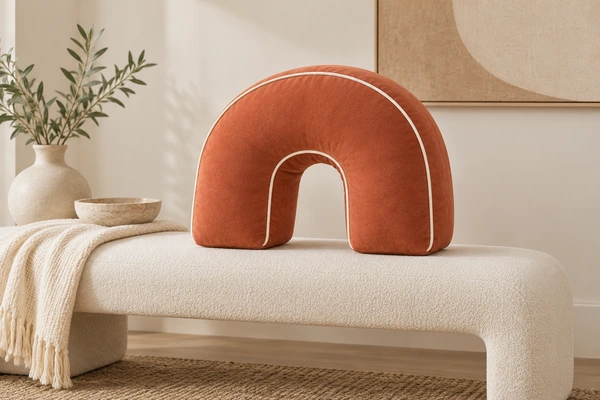
Specify custom plush cushions with a dimensioned sketch, named measurement points, a defined measuring condition and agreed tolerances. State whether each dimension describes the finished filled cushion, an unfilled cover or the retail package. These are different objects, and treating them as interchangeable can create avoidable sampling and quotation disputes.
Consider an illustrative terracotta arch cushion. Its overall width alone does not describe the opening, depth or curved profile. A useful brief for custom plush cushions shows how the shape should look and how the team will decide whether the sample matches.
The specification starts with the intended pose
Decide whether the cushion will be measured standing, lying flat or in another repeatable position. State whether it is unsupported and whether it should be allowed to recover after unpacking. Avoid squeezing the cushion to meet a target or stretching the cover while measuring it.
Choose one primary unit throughout the drawing. NIST’s conversion guidance is useful when supplying a secondary unit for another market. Keep the original target clear so rounded conversions do not create two competing acceptance limits.
Give every measurement a name
| Reference | Define for the arch example |
|---|---|
| Overall width | Widest outside points in the approved pose |
| Overall height | Base to highest outside point |
| Depth | Front-to-back thickness at a marked location |
| Opening width | Clear space between the inner sides |
| Opening height | Base to the inside curve |
| Profile | Approved front and side outline references |
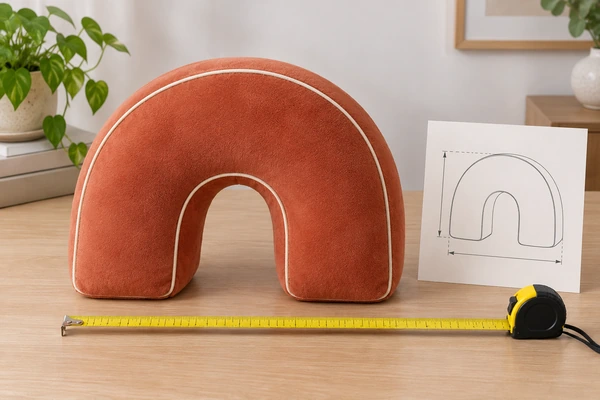
Use arrows that terminate at identifiable points. If pile makes an edge ambiguous, agree whether the measurement follows the fabric body or includes the visible pile. Discuss this during design development rather than resolving it after the bulk order arrives.
For a character cushion, also mark the positions of eyes, appliqué or a logo relative to a fixed reference. A decoration can be centered on its own panel yet appear off-center on the completed shape. Include the view from which the placement will be assessed.
Distinguish shape from fullness
A cushion can meet its outer dimensions and still look different because its filling is concentrated in the wrong places. Record the desired profile and fullness alongside the dimension sheet. The inner arch should not collapse unexpectedly, and the legs should have the agreed visual balance.
Ask the production team how fabric stretch, seams and filling will affect that result. Coats’ seam guidance offers background on the interaction between fabric and stitching. Confirm any revised construction with another sample instead of assuming a drawing change alone resolves the shape.
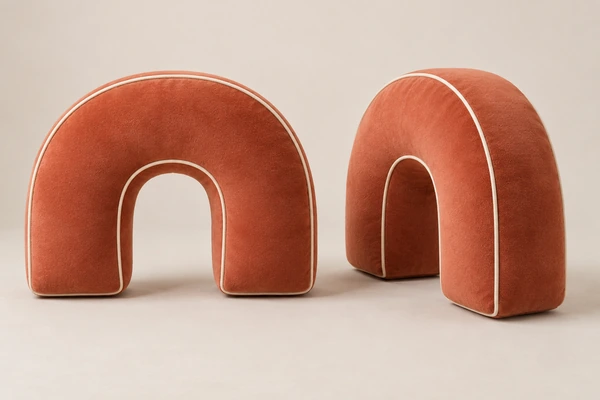
Agree tolerances around a real sample
Identify which dimensions are functional constraints. A cushion designed to fit a specific box or shelf may have a genuine maximum width, while a purely decorative curve may allow more visual interpretation. Explain those priorities to the supplier. Do not tighten every dimension equally when only one affects fit; focus the approval discussion on the constraints that matter.
Ask the supplier what variation is achievable for each dimension and why. Narrow openings, curves and overall width may not behave alike. Avoid applying a tolerance from rigid packaging to a soft filled product without considering the measuring method and intended use.
Review several representative samples if the project requires evidence of repeatability. Keep the measurement conditions consistent and record the actual values. Link the agreed limits to the inspection plan. The approved sample and the written limits should support each other, rather than leaving the inspector to choose between conflicting instructions.
Measure the package separately
Retail and shipping dimensions need their own fields. GS1’s package and product measurement standard is relevant when exchanging trade-item data. Review the GTIN rules if variants or dimensional changes affect identification.
Try the proposed cushion in its pack and check the unpacked result. Discuss transport testing with reference to ISTA procedures. A carton that closes successfully has not necessarily protected the cushion’s intended profile.
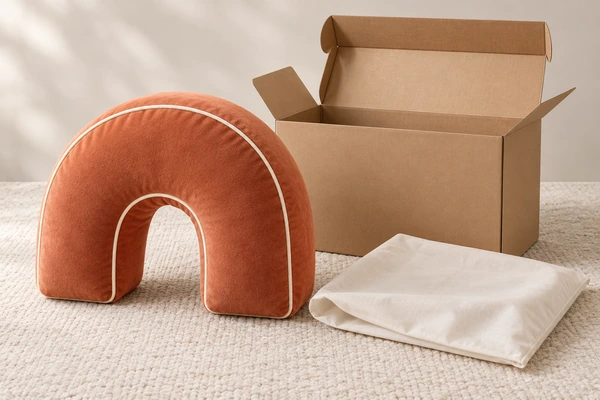
Close the specification before approving production
Keep materials, colors, care and labeling connected to the dimensional drawing. Use physical color references where appropriate, and review applicable household-textile information in the FTC labeling guide. These requirements cannot be inferred from shape alone.
Give the final document a revision number and identify who can approve changes. ISO 10007 provides a framework for configuration records. If the filling or fabric changes later, consider whether dimensions and profile need to be reviewed again.
Before sending the brief, ask someone unfamiliar with the concept to measure a sample from the drawing. Any question they need to ask identifies a definition that may be missing. Clarify the diagram before the order moves forward, and retain a completed measurement sheet as an example of the agreed method.
Review sampling questions and the supplier’s company information, then submit your cushion specification with the intended pose, dimensions and shape priorities.
Prepare your cushion specifications inquiry
Copy and complete this brief; mark unresolved items to confirm.
Company / contact:
Product / size / intended use:
Market / quantity / arrival date:
Finished dimensions:
Construction:
Use and care:
Email This BriefWhatsApp This Brief
Review and send it yourself, or paste it into our inquiry form.


[…] extensions. Use one primary unit and confirm conversions with the NIST conversion reference. Our size and shape guide helps make the measurement method […]
[…] the quoted carton dimensions are internal or external. Connect this information to the approved finished cushion dimensions; a revised pillow can invalidate an earlier packing […]
[…] same filling mass yet look different because the fill is distributed differently. Start with our size and shape specification guide, then build the measurement sheet […]