

A seasonal plush buying calendar should work backward from the date products must be ready for customers. Build separate timelines for each market, destination and sales channel, then connect them through shared design and production milestones. There is no reliable universal instruction to “order three months early” for every custom project.
For North American and European retailers, the useful output is a calendar with named owners, decision deadlines and contingency triggers. Start with the retail launch, not the holiday itself. A Christmas assortment needed for an early promotional display has a different arrival target from stock intended for the final shopping weeks.
Start at the shelf and count backward
Write down the first selling date, warehouse receipt deadline and date products must leave the supplier. Between those points, allow for receiving checks, allocation, labeling and store delivery. Use the seasonal sourcing guide to identify stages rather than assume a standard lead time.
Ask logistics partners for route-specific estimates and identify their assumptions. The shipping rule and named place should be clear under ICC Incoterms guidance. A supplier’s completion date is not the retailer’s arrival date. Keep customs, onward transport and warehouse booking responsibilities visible in the plan.
| Milestone | Decision required | Owner to name |
|---|---|---|
| Retail launch | Display and promotion ready | Merchandising |
| Warehouse receipt | Receiving and allocation capacity | Operations |
| Shipment release | Product and document readiness | Importer and supplier |
| Production approval | Signed sample and packaging | Product lead |
| Design freeze | Final variants and artwork | Brand and buying team |

Separate markets before combining orders
List the actual countries and distinguish Great Britain from Northern Ireland where relevant. Product requirements, language needs and importer responsibilities should be reviewed for each destination. Refer to U.S. CPSC guidance, Health Canada’s toy guidance, the European Commission’s toy-safety information and UK business guidance as appropriate. Confirm applicable rules and transition dates for the actual launch.
Schedule the review before packaging artwork is locked. A shared plush design can still need different labels or retail packs. Keep those variants in the purchasing file so a later artwork correction does not hold up every destination. Do not use a continental label such as “Europe” as a substitute for a market list.
Give each season its own assortment decision
Map the relevant occasions to your customer base and previous sales. Christmas, Easter, Halloween and Valentine’s Day may play different roles across stores. Compare local demand and the length of the selling window. A decorative symbol that works in one market may need adaptation elsewhere.
Plan a focused Christmas assortment, assess Easter basket fit, and decide the tone of Halloween designs separately. A common base character can simplify development, but every accessory and colorway still needs a defined approval status.

Use evidence to set the order, not just the calendar
Review prior sales by design, price, store and selling period. Distinguish a genuine demand limit from an early stockout. Inventory reports illustrate useful measures such as sell-through and remaining inventory; check your own system’s definitions before comparing results. Apply those observations to quantities across designs.
Build a base scenario and a reduced-order scenario. Name which designs would be removed first if the budget or schedule tightens. Protect the approval and compliance steps; simplify the range instead of assuming every remaining activity can be shortened. Record the latest date for each decision and who can authorize it.
Reserve time for packing and receiving checks
Keep one calendar with separate rows for each destination and a visible status for every milestone. Use “planned,” “confirmed” and “completed” consistently. A planned vessel departure should not be displayed as a confirmed delivery appointment. Add a column for the evidence behind each date, such as the supplier’s release confirmation or the warehouse booking. During weekly reviews, discuss changed assumptions first. This keeps the meeting focused on decisions and makes it easier to see whether one delayed component affects a single market or the entire program.
Approve the barcode and variant mapping before labels are printed, using GS1’s planning steps where relevant. Include packed dimensions, assortment contents and carton identification in the release review. Decide whether transport packaging needs assessment using an appropriate ISTA procedure. These checks belong before shipment booking becomes the only remaining decision.
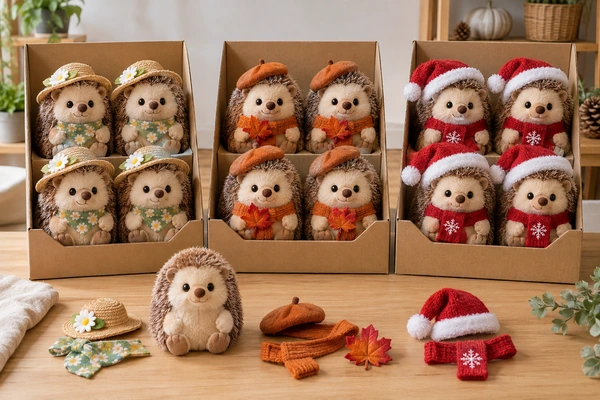
As an example, if sample approval slips beyond its agreed gate, the calendar should trigger a choice: reduce variants, change the launch scope or reassess the delivery route and cost. It should not quietly move every date while leaving the retail promise unchanged. Document the revised plan and circulate one current version.
Review the calendar at each milestone, then capture lessons after the season. Explore the seasonal plush collection and share your market and launch brief early enough for a realistic development discussion.
Prepare your seasonal buying inquiry
Copy and complete this brief; mark unresolved items to confirm.
Company / contact:
Product / size / intended use:
Market / quantity / arrival date:
Selling window:
Assortment:
Contingency:
Email This BriefWhatsApp This Brief
Review and send it yourself, or paste it into our inquiry form.